
How to Open a Guest House in Bulgaria in 2026: Registration, Requirements, Taxes and the Road to Your First Guests
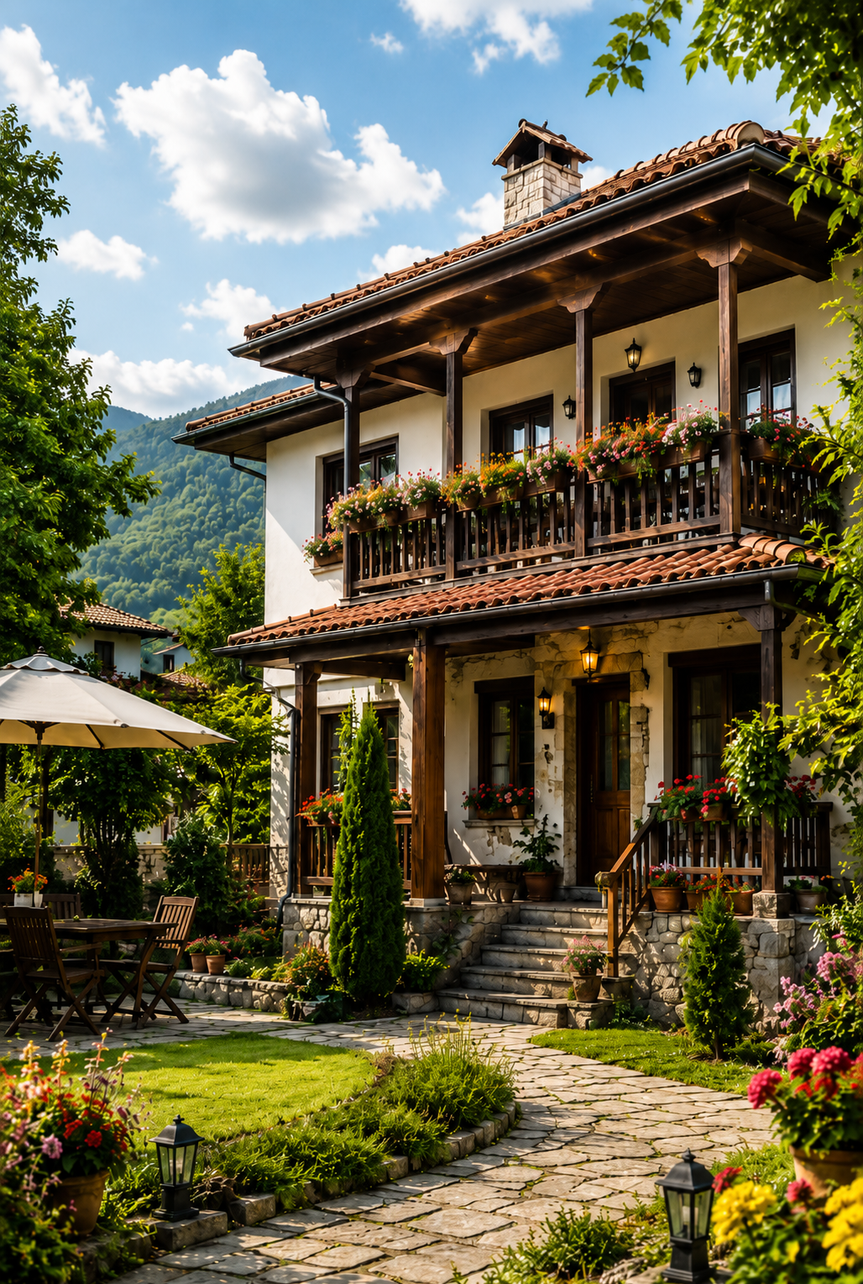
under Bulgarian law, not every house rented out for short stays automatically qualifies as a “guest house”.
What Is a “Guest House” Under Bulgarian Tourism Law?
A guest house is defined as a low-rise residential building with up to 10 guest rooms.
Guests may use shared areas such as:
- a living room;
- equipped kitchen;
- dining room or dining area;
- outdoor relaxation area.
An important part of the legal definition is that the property is managed by hosts who live in the same building or nearby, take care of the guests and provide food, with at least breakfast being included in the concept of the service.
This matters before you even begin the registration process.
If your business model is, for example, a fully independent luxury villa with no resident host and no food service, you should first verify whether “guest house” is the correct legal category or whether another type of accommodation establishment is more appropriate.
First determine the correct type of accommodation. Then invest in registering it.
Step 1: Check Whether the Property Can Be Used as a Guest House
Before you buy furniture, build a website or start advertising, check the property documents.
As part of the categorisation procedure, the applicant must declare the legal right to operate the business in the property.
If the person operating the guest house is not the owner, additional documentation may be required to prove the right to use the property.
In practice, check:
- ownership;
- the legal use and designation of the building;
- occupancy/use permits;
- whether the actual condition matches the official documents;
- whether there are unauthorised extensions;
- whether the property has the required capacity;
- whether there are appropriate bathrooms and sanitary facilities;
- whether access is safe;
- whether the property provides the shared spaces required for this type of accommodation.
If you are converting a residential property into a tourism business, check the building and planning requirements with an architect or the municipality before starting renovation work.
Step 2: A Guest House Must Be Categorised
A guest house is a Class B accommodation establishment and is subject to categorisation under the Bulgarian Tourism Act.
The category is determined based on minimum requirements concerning:
- the building;
- furnishing;
- equipment;
- services;
- service standards.
For guest houses, the competent authority is generally the mayor of the relevant municipality or an authorised municipal official.
So, if your guest house is located in Bansko, for example, you apply through the relevant municipality rather than directly through the Ministry of Tourism.
Step 3: What Documents Are Required?
The core document is:
an application-declaration for the categorisation of an accommodation establishment.
The procedure will normally require information and documents such as:
- application-declaration;
- applicant details;
- name of the guest house in Bulgarian and Latin characters;
- address and contact information;
- information proving the right to operate in the property;
- a document proving the right of use, where applicable;
- power of attorney if submitted through a representative;
- proof of payment of the administrative fee.
Municipal procedures follow the Tourism Act, but you should always check the exact document list with the municipality where the property is located.
Step 4: How Much Does Categorisation Cost?
There are two separate fees, which owners often overlook.
According to the fee structure cited in the Bulgarian administrative procedure, the fee for reviewing the documents for a guest house is:
€5.11 per bed.
After the category is granted, there is also a separate fee related to registration in the National Tourism Register, calculated according to the capacity of the property.
For example, with 12 beds:
12 × €5.11 = €61.32
for the first component alone.
Always verify the exact current fee with the municipality before submitting the application because administrative fees may change.
Step 5: How Does the Procedure Work?
After submitting the documents, the municipality reviews them.
If the application is complete, the categorisation procedure begins and a temporary certificate may be issued. According to the administrative procedure referenced in the Bulgarian version, this temporary certificate is valid for three months.
An initial processing period of around 14 days may apply at this stage.
A site inspection is then carried out.
The inspection checks whether the actual property and service conditions comply with the requirements for the requested category.
The overall administrative procedure may take around 104 days in some municipalities, including the temporary certificate stage and the final categorisation procedure.
After successful completion, you receive:
a category certificate + category sign.
These must be displayed in a visible place.
Step 6: The Category Is Not Permanent
A guest house category is valid for 5 years.
If you want to continue operating, you must begin the renewal/confirmation procedure before the existing category expires.
The Bulgarian administrative procedure referenced in the source provides that the renewal application should be submitted up to three months before the end of the five-year period.
This is one deadline worth putting in your calendar.
An expired category can mean that the property no longer has the right to legally offer tourist accommodation.
What Conditions Must a Guest House Provide?
The detailed requirements depend on the category, but they generally cover:
- construction and layout;
- furniture;
- equipment;
- services;
- service quality;
- safety;
- hygiene.
Basic requirements include providing safe and comfortable conditions for guests, maintaining technical equipment in good working order, appropriate heating and well-maintained access and accommodation areas.
Do not buy all the furniture first and only then check the requirements.
Check the requirements for the category you plan to apply for before furnishing the property.
That can save you from unnecessary renovation and replacement costs.
Breakfast Is Not Just an Extra
This is one area where a guest house differs from many other forms of accommodation.
The legal concept of a guest house includes the hosts taking care of guests and providing food, with at least breakfast forming part of the service.
Once you prepare and serve food, however, food-safety legislation also becomes relevant.
Before serving breakfast, check with the relevant Bulgarian Food Safety Agency authority what rules apply to:
- the kitchen;
- registration of the food premises;
- hygiene procedures;
- food storage;
- temperature control;
- traceability;
- allergen information;
- internal control procedures.
Do not assume that “it is only coffee, eggs and cheese” means food regulations do not apply.
Food safety is an area with real controls and real liability.
If You Have a Restaurant, the Rules Become More Complex
Serving breakfast to staying guests and operating a separate restaurant are not necessarily the same thing.
If the guest house includes a restaurant or entertainment venue that falls within the relevant regulatory regime, the venue may require separate categorisation, additional requirements and separate fees.
That is why your business plan should answer this question early:
Will I only provide breakfast to staying guests, or will I also operate a restaurant?
The answer changes the regulatory requirements.
After Categorisation Comes ESTI
Receiving your category certificate does not end your administrative obligations.
Anyone operating tourist accommodation, including a guest house, must submit information about accommodated tourists to Bulgaria’s Unified Tourist Information System — ESTI.
This requirement has applied since 1 October 2019.
The system records accommodation information, including guest arrival and departure.
Your internal process should therefore look something like:
reservation → check-in → guest registration → ESTI → check-out
Do not simply assume that your accountant will handle ESTI unless you have clearly agreed who is responsible for entering the information.
The National Tourism Register Is Also Important
After categorisation, the accommodation establishment is entered in Bulgaria’s National Tourism Register.
The register is public and allows both customers and authorities to verify that the property is legally entitled to offer tourist accommodation.
This can also help build trust.
Instead of simply claiming that your guest house is legally registered, guests can verify it.
Tourist Tax: Paid on Actual Overnight Stays
Guest houses are subject to tourist tax.
It is a local tax, which means the exact amount is determined by the relevant municipal council.
There is therefore no single national tourist-tax rate for all accommodation properties in Bulgaria.
For example, municipalities may require the tourist tax to be paid by the 15th day of the month following the month in which the accommodation was provided. There is also an annual declaration under Bulgaria’s Local Taxes and Fees Act.
In practical terms:
number of overnight stays × local tourist-tax rate = tourist tax due
How Is Guest House Income Taxed?
There is no single answer such as:
“You just pay 10% tax.”
The correct treatment depends on who operates the business:
- an individual;
- a sole trader;
- a company;
- another legally permitted entity;
and on how the activity is structured.
For systematic accommodation activity, you may need to consider:
- personal income tax or corporate tax;
- social-security contributions;
- VAT;
- local taxes;
- other business obligations.
This should be clarified with an accountant before the first sale, not at year-end.
VAT on Accommodation
Where the business is VAT-registered and provides taxable accommodation services, the Bulgarian tax authorities apply the reduced 9% VAT rate to accommodation in hotels and similar establishments, including holiday accommodation.
However, VAT registration itself must be assessed separately.
One particularly important area is commissions charged by foreign booking platforms, because specific VAT obligations may arise even before the normal turnover threshold for standard VAT registration is reached.
This is an area where professional accounting advice is strongly recommended.
Do You Need to Issue an Invoice?
Being able to issue the correct document is part of running a professional accommodation business.
A taxable person will generally issue an invoice for a supplied service or an advance payment.
Invoices may be required regardless of whether the supplier is VAT-registered, although there are situations where an invoice is not mandatory for certain supplies to private individuals. An invoice may also be issued when requested.
Your guest house should therefore be ready to serve:
- an individual tourist;
- a business customer requesting an invoice;
- an employee travelling on business;
- an advance payment;
- a travel agency;
- a group booking.
Corporate customers may choose accommodation partly because invoicing is properly organised.
What About a Fiscal Receipt?
An invoice and a fiscal receipt are not the same document.
Sales made through a commercial establishment may generally need to be recorded with a fiscal or system receipt unless the payment method falls under a specific exemption, such as certain bank-transfer or direct-debit payments.
In other words:
“I issued an invoice” does not automatically mean “I do not need a fiscal receipt.”
The payment method matters.
Your accountant should help you establish the process before you start:
reservation → payment → document → accounting
Fire Safety Is Not a Formality
Guest houses fall within tourism-related building categories under Bulgarian fire-safety rules.
The owner or operator is responsible for complying with the applicable fire-safety requirements.
At a minimum, review:
- fire extinguishers;
- evacuation routes;
- clear exits;
- safety signs;
- electrical systems;
- heating appliances;
- gas systems;
- chimneys and fireplaces;
- emergency procedures;
- access for emergency services.
If you offer a fireplace, barbecue, sauna or other higher-risk facilities, organise this area professionally.
Is Insurance Mandatory?
The Bulgarian source text notes that no general requirement was identified requiring every guest house to carry a specific mandatory insurance policy equivalent to the compulsory liability insurance applicable to tour operators.
However, operating a guest house without appropriate insurance is a significant business risk.
A well-designed policy may cover:
- the building;
- furniture;
- fire;
- flooding;
- natural disasters;
- theft;
- equipment;
- broken glass;
- accidents;
- liability towards guests;
- liability towards third parties;
- business interruption, where offered.
Most importantly:
tell the insurer explicitly that the property is being used as a guest house.
Insurance intended for a private home is not necessarily equivalent to insurance for a property receiving paying guests throughout the year.
Your Guests Also Need Protection
You are entering into business relationships with consumers.
That means the following should be clear:
- prices;
- booking conditions;
- cancellation conditions;
- included services;
- deposits;
- house rules.
Do not advertise:
“€120 per night”
and only after the booking reveal:
- cleaning fees;
- heating fees;
- pool charges;
- firewood charges;
- compulsory breakfast fees;
- security deposits;
- other additional costs.
A clear total price is not only good marketing.
It builds trust.
Cancellation Rules Should Be Clear Before Booking
Before you accept your first reservation, decide:
- is an advance payment required?
- is it refundable?
- until when can the guest cancel free of charge?
- what happens in case of no-show?
- is there a minimum stay?
- what happens if the guest leaves early?
- when is the security deposit returned?
These rules should be written in advance, not invented once a dispute has already started.
Activities and Amenities Can Increase Both Price and Occupancy
A house with six bedrooms is a product.
But:
six bedrooms + swimming pool + barbecue + children’s area + view + bicycles + board games
is already an experience.
For a guest house, a large part of the value can be created outside the bedroom.
Consider:
- swimming pool;
- hot tub;
- sauna;
- barbecue;
- fire pit;
- children’s play area;
- garden;
- swings;
- bicycles;
- board games;
- table tennis;
- billiards;
- workspace;
- EV charging station;
- transfers;
- hiking routes;
- local tastings;
- horse riding;
- fishing;
- mountain guides;
- local craft workshops.
But there is one important rule:
if an activity is regulated, do not simply offer it because guests would enjoy it.
Check the applicable requirements for the activity and the provider.
Music for Guests Can Create Additional Obligations
If you play protected music in common areas, a restaurant or entertainment space, obligations related to copyright and neighbouring rights may arise.
Public performance of music in a commercial tourism or hospitality setting may require the relevant rights to be cleared.
A personal Spotify subscription should not automatically be assumed to provide the necessary licence for music in a commercial property.
A Good Guest House Needs Clear House Rules
Before opening, define:
- check-in time;
- check-out time;
- maximum capacity;
- policy for additional guests;
- pets;
- smoking;
- parties;
- noise;
- parking;
- pool use;
- barbecue use;
- children;
- damages;
- security deposit;
- lost keys;
- electric-vehicle charging;
- use of common areas.
This is not being unnecessarily strict.
It prevents conflicts.
Do Not Underestimate the Emergency Plan
Imagine this:
23:40.
A guest calls:
“We have no water.”
or:
“The key broke.”
or:
“The electricity has gone out.”
or:
“Water is coming out of the bathroom.”
Who goes to the property?
Who has a spare key?
Who knows where the main water valve is?
Do you have a plumber?
An electrician?
Who cleans up after an emergency?
Who can speak English if the guest is foreign?
These situations are often what separate a successful guest house from a merely beautiful property.
Do Not Sell Only an “Overnight Stay”
This is the marketing mistake many owners make.
A guest is not searching for:
“a 280 sq.m house.”
They are searching for:
“a place for 10 people where the children can play outside and everyone can sit together around one table in the evening.”
Another guest wants:
“a quiet weekend house for friends.”
Another wants:
“a Christmas house for three families.”
Another wants:
“a remote-work property with reliable internet.”
Your listing should make it immediately clear who the property is suitable for.
What Photos Should a Guest House Listing Include?
Do not photograph only the bedrooms.
Show:
- the exterior;
- the garden;
- the view;
- the large shared dining table;
- the kitchen;
- every bedroom;
- bathrooms;
- parking;
- access to the property;
- children’s facilities;
- swimming pool;
- barbecue;
- fire pit;
- surrounding area;
- nearby attractions.
And use video.
Guest houses are one of the property types where video can show how the different spaces connect to one another much better than isolated photographs.
Your Price Should Be Calculated, Not Copied
Do not simply look at the guest house next door.
Calculate your own costs.
Fixed costs:
- mortgage/rent;
- insurance;
- internet;
- accounting;
- software;
- salaries;
- security;
- depreciation.
Costs per booking:
- laundry;
- cleaning;
- consumables;
- breakfast;
- electricity;
- water;
- heating;
- commissions;
- tourist tax.
Then determine:
minimum profitable price + seasonality + demand + capacity
A guest house charging €500 per night but occupied for only 20 nights a year may be a weaker business than one charging €300 and occupied for 120 nights.
The Most Important Metric Is Not the Nightly Rate
It is occupancy at a healthy average rate.
Track at least:
- occupancy rate;
- average nightly rate;
- average booking value;
- average length of stay;
- repeat guest rate;
- where bookings come from;
- booking cancellations;
- which periods remain empty;
- which property features generate the most interest.
Over time, this shows you what guests are actually buying.
How Dealehome Can Help Improve Guest House Occupancy
This is no longer about legal registration.
Dealehome does not replace the municipality, ESTI, the National Revenue Agency or the Bulgarian Food Safety Agency.
It helps with the next problem:
Once the guest house is ready and legally operating, how does the right guest find it?
For guest houses, searching only by location + price is often not enough.
One group may be looking for:
12 guests + 5 bedrooms + pool + barbecue
A family may want:
6 guests + garden + children’s area + parking
A company may need:
10 people + reliable internet + separate bedrooms + invoice
This is where structured property information becomes useful.
In Dealehome, a guest house can be presented through specific characteristics, number of guests, amenities, map location, photographs and video, rather than hiding everything inside a long description.
This works in two directions.
For the guest:
it becomes easier to find a property that genuinely matches the size of the group and the type of stay they are planning.
For the owner:
the listing can reach more relevant searches and reduce unsuitable enquiries.
Direct contact is also particularly valuable for guest houses because larger groups nearly always have additional questions:
“Can we be 11 instead of 10?”
“Are there three children’s beds?”
“Can we rent the entire house?”
“Is there parking for five cars?”
“Can you issue an invoice?”
“Are dogs allowed?”
“Is the swimming pool heated?”
When these questions can be clarified directly, the path from search to booking becomes shorter.
A detailed listing also does something else:
it creates more accurate expectations before the guest arrives.
Less difference between the photographs, the description and the actual experience means:
- more satisfied guests;
- stronger recommendations;
- a higher chance of repeat bookings.
Occupancy does not come only from more people seeing the guest house.
It comes from the right people finding it.
And that is where Dealehome can help most.
Frequently Asked Questions
Does a guest house in Bulgaria need to be categorised?
Yes. Guest houses are Class B tourist accommodation establishments and are subject to categorisation. Only properly categorised or registered accommodation establishments may legally provide tourist accommodation.
How many rooms can a guest house have?
Under the definition used in the Tourism Act, a guest house may have a maximum of 10 guest rooms.
Does a guest house have to provide breakfast?
The legal definition describes a guest house as an establishment where the hosts take care of the guests and their meals, with at least breakfast being provided. Where food is prepared and served, the applicable food-safety rules must also be checked.
Do I need to issue invoices to guests?
Business activities are subject to Bulgaria’s rules on documenting sales. Invoices may be required depending on the transaction and can also be issued on request. Separately, it must be determined whether the particular payment also requires a fiscal receipt.
How do you open a guest house in Bulgaria in 2026? A detailed guide covering categorisation, ESTI, tourist tax, food service, invoicing, insurance and attracting guests.
guest house registration Bulgaria, guest house categorisation Bulgaria, how to open a guest house in Bulgaria, guest house taxes Bulgaria, tourist tax guest house Bulgaria, ESTI guest house Bulgaria, invoice for accommodation Bulgaria, guest house requirements 2026


